Showing posts with label Soviet Jews. Show all posts

Monday, July 2, 2012

Jews in Sport in the USSR

The destruction of the Maccabi sports club and other Zionist organizations by the Bolsheviks after the 1917 Revolution by no means destroyed the attraction of Soviet Jews to sports. Jews participated actively in the athletic life of the Soviet Union on many different levels, and their achievements were impressive. For example, track and field athlete Robert Liul’ko (multiple USSR champion and record holder in all sprint events and the long jump, 1934–1940) and weightlifter Moisei Kas’ianik (1937 Antwerp International Workers’ Olympiad winner, 1946 World Championship and 1947 European Championship bronze medalist) were quite celebrated in the 1930s. Until the beginning of the 1950s, however, Soviet athletes participated only sporadically at sporting events because the USSR was an essentially closed society.


Tamara Press in the discus competition at the Summer Olympics, Tokyo, 1964. (IOC/Olympic Museum Collection)

The situation began to change after World War II, when the Soviet national team participated in the 1946 weightlifting world championship. At this competition, the Jewish athlete Grigorii Novak became the country’s first world champion in any sport. The first major showing of Soviet athletes at an international event occurred at the 1952 Olympic Games in Helsinki; there, too, Soviet Jewish athletes were prominent. Gymnast Maria Gorokhovskaia (the first Olympic champion not only in the history of Soviet gymnastics but also in the history of world female gymnastics, as this title was first included in the Olympic program in Helsinki) was 1952 Olympic multievent and team champion and silver medalist in all gymnastic disciplines; she established a record by winning seven medals at a single Olympic Games and was 1954 world team champion and multiple USSR champion. The Greco-Roman style wrestlers Boris Gurevich (the first Olympic champion in the history of Soviet wrestling and the first Soviet Jewish Olympic champion; 1953 and 1958 world champion) and Iakov Punkin (also USSR champion in 1949–1951 and 1954–1955) won gold medals; Grigorii Novak (1946 world champion, 1947 European champion, and multiple USSR champion) won a silver medal in weightlifting; marksman Lev Vainshtein (multiple world, European, and USSR champion) received a bronze medal; and Boris Goikhman (1956 Olympic bronze medalist, 1958 European Championship bronze medalist, 1960 Olympic medalist, and multiple USSR champion and cup holder), the goalkeeper for the Soviet state Olympic water polo team, was part of the symbolic (or “fantasy”) world all-star team.

Other noted athletes included the wrestlers Grigorii Gamarnik (1955 world champion, 1958 world championship silver medalist, and multiple USSR champion), Oleg Karavaev (1960 Olympic champion, 1958 and 1961 world champion, multiple USSR champion), and David Rudman (1969 world championship bronze medalist, 1969 and 1970 European champion). In track and field, Mariia Itkina (1954, 1958, and 1962 European champion, multiple world-record holder and USSR champion) and the sisters Tamara (1960 and 1964 Olympic champion, 1960 Olympic silver medalist) and Irina (1960 and 1964 Olympic champion) Press won numerous competitions. In fencing, legendary masters included Grigorii Kriss (in 1964 became the first Olympic champion in the history of Soviet individual fencing, 1968 Olympic silver medalist, 1972 Olympic bronze medalist, multiple world and USSR champion), Mark Midler (1960 and 1964 Olympic team champion, multiple world champion), and David Tyshler (1956 Olympic bronze medalist, multiple world championships silver medalist). Water sports were won by Valentin Mankin (Olympic champion, 1968, 1972, and 1980; multiple world champion), Semen Belits-Geiman (1968 Olympic silver and bronze medalist, multiple European and USSR champion), Leonid Geishtor (1960 Olympic champion, 1963 world champion, multiple European and USSR champion), and Boris Goikhman. Soccer heroes included Viktor Kanevskii (1961 USSR champion and 1964 national cup holder; played many times for the USSR national team), Leonid Ostrovskii (world championship bronze medalist, multiple USSR champion), Eduard Markarov (world championship bronze medalist, USSR champion and national cup holder), and Boris Razinskii (USSR champion; played many times for the national and Olympic team). And colorful figures in world-class figure skating included Aleksandr Gorelik (1968 Olympic silver medalist, multiple world and European championships medalist) and Gennadii Karponosov (1980 Olympic champion; multiple world, European, and USSR champion and medalist).


Lev Vainshtein accepting the bronze medal for marksmanship at the Olympics, Helsinki, 1952. (IOC/Olympic Museum Collection)


Jewish coaches, in addition to athletic champions, were prevalent in Soviet sports. Especially notable were the following figures: in track and field athletics, Lev Al’terman and Pavel Goikhman; in basketball, the brothers Aleksandr (TzSKA [Moscow] chief coach in 1960–1968, when this team was USSR champion 15 times; included in the NBA Hall of Fame) and Evgenii (chief coach of the Soviet and SNG women’s national teams, which were 1992 Olympic champions and 1986 and 1998 world silver medalists) Gomel’skii; in fencing, David Tyshler and Iulii Uralov; in soccer, Mikhail Tovarovskii (founder of the Soviet soccer coaching school); in rhythmic gymnastics Irina Viner; and in winter sports, Boris Vasil’kovskii, Natal’ia Dubova, and Nikolai Epshtein.

Under the totalitarian regime, high-level sport tended to be an important aspect of politics. Soviet sport was infected with antisemitism, and this situation forced some outstanding Jewish athletes to camouflage their origins. Those who did not, suffered from discrimination. Jewish athletes were often not permitted to travel abroad and thus could not always partake in major competitions. Soviet officials also determined which sports figures would be awarded honorary titles, and had control over other matters that guaranteed the quality of life of athletes.

Still, Soviet Sport officials could not violate the established and generally recognized norms too openly. Authorities could not, for example, cancel the automatic awarding of the title Honored Master of Sport of the USSR to Olympic gold medal winners. However, they could and did avoid granting this title to Jewish athletes who won not gold but silver medals but were clearly worthy of this title by the totality of their achievements.

Soviet Jewish coaches were treated in similar fashion. Ultimately, writers working for antisemitic authorities were given a completely free hand in commemorating achievements in sports and in writing the history of the field. Eloquent testimony to the discrimination they practiced is reflected by the complete absence in leading Soviet reference works (such as the multivolume Bol’shaia sovetskaia entsiklopediia [Great Soviet Encyclopedia] and the one-volume Sovetskii entsiklopedicheskii slovar’ [Soviet Encyclopedic Dictionary]) of individual entries on such athletes as Iurii Vengerovskii (1964 Olympic champion, 1962 world champion, multiple world and European championships medalist), Grigorii Kriss, Mark Midler, Mark Rakita (1964 and 1968 Olympic champion, 1968 and 1972 Olympic silver medalist, multiple world champion), and David Tyshler, to mention only some of the leading figures in popular sports such as volleyball and fencing.

This was all the more true for the less popular types of sport. Soviet reference works contain no biographical information on, for example, David Rudman, who not only promoted Russian Sambo, a martial art originating in the Soviet Union—and was one of the outstanding judo practitioners in the world—but also founded a youth club in Moscow to serve fans of Sambo wrestling.

After the collapse of the Soviet Union, Jewish athletes from the region continued to compete. Most often, though, they were members of sports contingents from Israel, the United States, Canada, Germany, and Australia.

Suggested Reading

Uri Miller, Sport v istorii evreev i evrei v istorii sporta (Rostov on Don, Rus., 2000); Leonid L’vovich Mininberg, Evrei v rossiiskom i sovetskom sporte, 1891–1991 (Moscow, 1998).

Author

Friday, June 15, 2012

The Aircraft Plot

Forty-two years ago today, on June 15, 1970, a group of Soviet dissidents gathered at Smolny Airport outside Leningrad. They had bought all the seats on a 12-passenger aircraft headed 240 miles northwest to Priozersk, near the Finnish border. Upon landing, they intended to hijack the plane, deposit the crew in a nearby forest, and fly to Sweden, where they would hold a press conference to call attention to the plight of Soviet Jewry. They would then immigrate to Israel.


Ten of them were Jews. One, 22-year-old Yosef Mendelevich, had applied for a visa to immigrate to Israel three times and been rejected three times. Another dissident, Sylva Zalmanson, later told the magazine Novoe Russkoe Slovo that the travelers were terrified by the prospect of punishment but felt almost possessed, as if beckoned by magical powers: They had made their decision against Soviet life, and attempting escape was the only course. Two of the dissidents were Christians. One of them, Yuri Fedorov, had already served three years in labor camps for circulating anti-regime literature.

But the samoletchiki ("airplane guys"), as they came to be known, never made it to the plane. Heading toward the tarmac, they were tackled, beaten, and arrested by KGB officers. They did not see each other for the next six months, as the KGB attempted to wear them down and extract confessions. In December 1970, they were all found guilty of treason for attempting to leave the country illegally.
Most of the group received sentences of four to 15 years. But Eduard Kuznetsov, the leader of the group, and Mark Dymshits, the intended pilot, were sentenced to death by firing squad. After world outcry, the death sentences were commuted to 15 years in the gulag.
The samoletchiki said they did not regret their actions. In the 2007 documentary Refusenik, Mendelevich described a moment of uncertainty after the arrest, asking himself, "You admit that it was a stupid thing to do? Now you are a prisoner. Everything is lost!" But the moment was brief. He had been willing to sacrifice his life for the right to live in Israel. Now he knew his love for the country was real.
Another member of the group, Anatoli Altman, did not regret a day of the nine years he spent in a labor camp. Every morning he woke to the monotony and suffering of gulag life. But he knew that each time he let his guard down, the camp re-education system, designed to break him as an individual, would come one step closer to transforming him into another interchangeable Soviet chattel, Homo sovieticus. "I was put in a position," he remembered, "where I was forced to make choices. Would I keep my human dignity, my personal dignity? I discovered inner strengths I didn't know I had."
Still another of the group, Boris Penson, a 24-year-old graduate of the Academy of Arts in Riga, spent nine years in Soviet prison camps. His friends were able to smuggle some of his art to Israel. Thus, in 1972, while he was serving his term, New York's Jewish Museum showcased his work in an exhibit called "Art from a Soviet Prison." Reflecting on his ordeal, Penson affirmed that "freedom was worth it," especially for the people who were able to reach Israel because of him.
At the time of the aircraft arrests, Boris Gorbis, who later founded the America-Israel Museum in Los Angeles, was completing his last year at Odessa University. There were rumors about the hijacking, but the first official news of it appeared in Izvestia only in early 1971. After the trial, the KGB prepared for more arrests and interrogations. Memories of the 1952-1953 "Doctors' Plot," an anti-Semitic show trial, weighed heavily on the minds of Soviet Jews.
But as news of the prosecutions spread, the Soviet Union came under international scrutiny. Within a month of the trial, people started receiving permission to emigrate. In 1971, 13,000 exit visas were granted; in 1972 there were 32,000. The flow would prove temporary, but world opinion had forced the Soviets to make a show of granting exit visas. The invincible regime had been set back. In May, 1971, Gorbis began applying for permission to leave the Soviet Union.
In April, 1979, five of the samoletchiki finally arrived in Israel, greeted with a celebration at Ben Gurion Airport. Altman, by then 38, remembered the shock of arriving in Tel Aviv, still sporting his short prison haircut, and being received as a hero. When it was time for him to address the crowd, he was unable to speak. It suddenly dawned on him that he was standing at the doorstep to the land of Israel, from which his ancestors had been driven 2000 years ago. Now, he was returning; the circle was complete.
Dymshits and Kuznetsov were freed in May, 1979 as part of a U.S.-Soviet swap of five Soviet dissidents for two Soviet spies. Yuri Fedorov, the last to be released, spent a total of 18 years in prison camps; he arrived in the United States in 1988. He visited Russia in 1998 and discovered that thousands of former dissidents were suffering from poverty and disease. The Free World had forgotten the individuals who had sacrificed their lives and health to bring about the collapse of the Soviet Union. Fedorov returned to the United States and established the Gratitude Fund, which raises money to provide the former dissidents with medical and emergency assistance.
The samoletchiki awakened the world to the desperate plight of Soviet Jewry. No longer could the West attribute the absence of protest in the Soviet Union to satisfaction with the regime; here were individuals so desperate to escape that they were willing to undertake a mission in which capture was almost certain. They understood that there could be no Jewish life in the Soviet Union and pursued liberation knowing that their path might well lead them to the gulag. "Americans need to hear," Fedorov drew the lesson, "that in every country and in every nation, freedom is not free." The noise the samoletchiki made reverberated throughout the world, proclaiming that Soviet Jewry would neither be forgotten nor silenced until freedom was theirs.

Friday, February 10, 2012

Jewish women of the Famous Russians.

Jewish women of the Famous Russians.


The wives of Sergei Kirov, Plekhanov, M.G. Pervukhin were Jewish. Jewish wife of Yezhov, Rykov (sister of the architect Iofan), Kamenev (Trotsky's sister), were killed by Stalin before the war. Nikolai Ivanovich Bukharin, had not one but even two Jewish wives, Esther Isaevna Gurvich and the daughter of a Bolshevik Larin ( Michael Lurie), Anna.

Kliment Voroshilov in exile married Golda Gorbman (in order to register their marriage officially, converted to Orthodoxy under the name Ekatenina). They did not have children of their own and raised five adapted kids two of which were Mikhail Frunze’s children.

At the end of 1948 by the Stalin’s orders all Jewish wives of Soviet government officials were arrested: The list included wives of :
Andreyev - Dorah Moiseyevna Hazan,
Poskrebyshev - Bronislawa Solomonovna, she was the Trotsky’s sister in law, imprisoned for 3 years and later executed in a same prison
and
Molotov – Polina Zhemchuzhina (Pearl Karpovsky .)

For many years the Rosa Kaganovich (Lazar Kaganovich’s sister or niece) was a Stalin’s mistress (even their medical records were kept together in the Kremlin clinic). According to Beria’s son Sergo Beria, their proximity was the direct cause of suicide of Nadezhda Alliluyeva. Rosa had a Stalin’s child, the boy's name was Yuri, and he grew up in a Kaganovich’s family.

One time, Lily Brik was the wife of the Civil War hero the corp commander V. M. Primakov (who led the invasion of the Red Army in Afghanistan( back in a 30’s).
Nikolai Shchors was married to a Jewess Fruma. Their daughter, Valentina married the famous Soviet physicist Isaac Markovich Khalatnikov.

Jewish women were the wives of:
Korney Ivanovich Chukovsky (himself a Jew by his father),
Leonid Andreyev,
Arkady Gaidar
and Vladimir Tendryakov.

Vladimir Nabokov had serious relationships with two Jewish women and a third, Vera Slonim, became his wife.

The famous song of Alexei Surkov:

"Ты сейчас далеко, далеко.
Между нами снега и снега.
До тебя мне дойти нелегко,
А до смерти четыре шага...",

"You're far, far away.
Between us snow and snow.
It is hard for me, to reach you,
But the death is four steps away ... "

was addressed to his wife, Sophia Abramovna Krevs.

Chukovsky wrote in his diary : "May 13, 1956. Fadeev shot himself. I just thought about one of his widow, Margaret Aliger who loved him very much."

Valentin Kataev - wife Esther Davidovna. Their daughter Eugenia married a Jewish poet Aron Vergelis, who was an editor of "Sovetish geymland" for many years, the official Soviet Jewish anti-Zionist-collaborator.

Composer Alexander Serov was the son of a converted Jew from Germany Karl Gablitz, who later became a Russian Senator and vice-governor of Tavrias district (Crimea and area north of it next to the Black Sea). Serov had married a woman of Jewish descent, pianist Valentina Bergman, with whom he had a son – famous Russian impressionist painter Valentin Serov.

Wife of the official Soviet composer Tikhon Khrennikov, the head of the Composers' Union in the Stalin’s years was Jewess Clarah Arnoldovna.

Innocent Smoktunovsky in an interview to Israeli media was saying: "My wife is - a Jew. Her name is Shlomit. She was born in Jerusalem, near the Western Wall. In the 1930 then she was little, her mother took her to Crimea, where the Jewish farming commune was formed by that time. There they were stripped of everything , and half of them ended up in the jail. My wife's mother returned to Jerusalem just two years ago… "

The wife of Boris Savenkov was – E. L. Silberg.
Wife of Sergei Witte was a Jewish woman. He himself was a descendant of one of the daughters of Peter Shafirov.

We probably could go on and on, but it is supposed to be a small article not to over burden you with many names. But it is big enough sample to get a picture.

Tuesday, November 15, 2011

О том как классик белорусской литературы Янка Купала из Подмосковья отправлял телеграмму на идиш.

For ones who dose not know how to read  in russian go to the second half of the post.
------------------------------------------------------------------------------
Где-то году в 1936-м в подмосковный дом отдыха приехали три поэта из Белоруссии: Янка Купала, Изи Харик и Зелик Аксельрод. Причем, если Купала писал по-белорусски, то его спутники стихи писали на родном для них языке идиш. Отдых сразу пошел в «правильном» направлении, и уже к вечеру третьего дня все взятые с собой деньги волшебным образом превратились в головную боль и гору пустой стеклопосуды. Пришлось поэтам тащиться на почту и давать слезную телеграмму в Минск, чиновнику по фамилии Лесин, ответственному за материальное благосостояние белорусской литературы. Всплеск поэтического вдохновения, усугубленный голодом и похмельем, привели к тому, что телеграмма получилась в стихах и заканчивалась следующим эпохальным двустишием:

Мир без денег тесен,
Хоб рахмонэс, Лесин
.

Загадочные слова «хоб рахмонес» не составляли никакой загадки ни для Лесина, ни для Купалы, как и для большинства бывших жителей черты оседлости. В переводе с идиш это означает «имей сочувствие». Однако составители телеграммы не учли, что в Подмосковье, в отличие от родной Белоруссии, ни языка идиш, ни их самих никто не знает. Телеграфистка, прочитав бланк телеграммы, сказала «подождите минуточку», исчезла в глубине отделения связи и вскоре вернулась в сопровождении молодого человека в милицейской форме. Милиционер подошел к растерявшимся писателям и грозно спросил:
— Что за непонятные телеграммы посылаете, граждане? Может быть, это шифр такой? Может быть, вы шпионы?
Несмотря на анекдотичность ситуации, неприятности могли последовать более чем серьезные. Объяснять про язык идиш не следовало: первые звоночки в виде закрытия еврейских школ уже раздавались. Необходимо было срочно придумать «отмазку». И гениальный поэт Купала ее придумал.
— Товарищ, — сказал он милиционеру, — какой шифр, о чем вы? Это же просто подписи. Это наши фамилии в телеграмме. Вот он, — Купала указал на Харика — Хоб, а этот, — он кивнул в сторону Аксельрода — Рахмонэс, ну а я — Лесин. Вот и всё.
Милиционер посмотрел на Харика и подозрительно переспросил:
— Хоб?
— Хоб, Хоб, — с готовностью подтвердил тот. — Белорусский писатель Изи Хоб.
Аксельрода милиционер не стал даже спрашивать. И так было видно, что фамилия Рахмонэс подходит к нему как хорошо сшитый костюм.
Телеграмма была благополучно отправлена, новоявленные Хоб, Рахмонэс и Лесин получили аванс за никогда не изданную книгу, и отдых продолжился. Увы, это был последний случай, когда поэтам удалось обмануть бдительность органов. Харик был арестован и расстрелян в 1937 году как член «троцкистско-зиновьевского блока», Аксельрод — в 1941-м. Купала погиб в 1942-м при невыясненных обстоятельствах: разбился, упав в лестничный пролет гостиницы «Москва»...
--------------------------------------------------------------------------------------------------------------------

Story as it was promised , in a begging of the post for English speaking readers of my blog.

In 1936 three poets came from Belarus (Yanka Kupala, Izi Harik and Zoellick Axelrod) to the resort near Moscow, And, if Kupala wrote in Belarusian, his companions were writing poems in their native Yiddish. The rest went straight to the "right" direction, and by the evening of the third day all the money taken for development of new Byelorussian masterpiece magically turned into a headache and an empty mountain of glassware. Poets had to go to the post office and give telegram to Minsk to official named Lesin, responsible for the economic welfare of Belarusian culture and literature in general. Splash of poetic inspiration, aggravated by hunger and hangover, have led to the telegram which  turned into verse and ended  with a following a landmark phrase:


A world without money is too small,
Hob rahmones, Lesin.
( believe me, it rimes vary nicely in Russian)

Mysterious words "Hob rahmones" did not constitute any puzzles  for Lesin, nor for Kupala, as for most of the former inhabitants of the Pale. Translated from the Yiddish meaning "Have a sympathy." However, the poets failed to realize that in the Central Russian region, in contrast to their native Belarus, neither Yiddish nor them no one knows. Telegraph operator, after reading the telegram form, said, "wait a minute," disappeared in the depths of the office and soon returned, accompanied by a young man in police uniform. A policeman approached and angrily bewildered asked writers:
- What a strange telegram you are sending? Maybe you are trying to send coded message, are you hiding something? Maybe you are spies?
Despite the anecdotal situation, more than serious trouble could follow. Explanations about the Yiddish language would not help much: the first steps in the form of the closure of Jewish schools have already been done. It was necessary to come up with " urgent excuse." And the genius of Kupala thought of one write away.
- Comrade, - he said to the policeman, - a code, what are you talking about? This is just a signature. This is our last names in the telegram. Here he is - Kupala indicated to Harik - Hob, and he is - by nodding toward Axelrod - Rahmones, well, and I am - Lessin. That's it.
The policeman looked  suspiciously and asked toward Harik:
- Hob?
- Hob, Hob - readily confirmed Belarusian writer Izzy Haub.
Axelrod was not even asked. And so it was obvious that the name Rahmones fitted him as well-tailored suit.
The telegram was successfully sent. The day latter Hob, Rahmones and Lesin received an advance for a book what never was published, and the rest continued. It was the last time the poets managed to deceive the authorities. Harik was arrested and executed in 1937 as a member of the "Trotsky-Zinoviev bloc," Axelrod - in 1941. Kupala was killed in 1942 under mysterious circumstances: by falling into the stairwell of the hotel "Moscow" ...

Monday, October 10, 2011

Less known Marshak (part 2)


Check out another poem by young Marshak, which was published in one of Jewish Odessa Periodicals, right after one of many pogroms which were happening all over Russia during first decade of XX century. Marshak tells us story of Inquisition, life and suffering of Spanish Jews back some 400 years ago, but we clearly could see what Marshak is traying to tell as by going back to the history. The parallels are obvious. Same Samuil Yakovlevich Marshak , same talent  but completely different poet with completely different view on life and self expiration.

Don't get me wrong I love Marshaks' work, however I like this Marshak much more.


Инквизиция
 
На Пасху, встречая свой праздник свободы
Под низкие своды спустились они.
Казалось, звучали шаги в отдаленьи,
И глухо дрожали крутые ступени,
И тускло горели огни.

        Семья притаилась за скатертью белой...
        Могучий и смелый, лишь он не дрожал,
        И встал он пророком
        В молчанье глубоком,
        И взором окинул подвал.

И тихо он начал: "Рабами мы были!"
Но в темной могиле, в подвале немом
Мы гордо повторим: "мы были, мы были!
Теперь мы тяжелое иго забыли -
И дышим своим торжеством!"

        Пускай мы пред смертью, пускай мы в подвале -
        Грядущие дали не скрыл этот свод!
        И нашей свободы никто не отнимет...
        Пусть голову каждый повыше поднимет
        И смерти бестрепетно ждет!
        "Мы были рабами! Мы были! Мы были!"

И вдруг позабыли свой ужас они:
Они не слыхали в минутном забвеньи,
Как глуше, сильней задрожали ступени,
И дрогнули робко они.
Вскочили... Столпились... Слетела посуда,
Как мертвая груда... Застыли и ждут.

        И отперлись двери - и черные звери
        По лестнице черной идут.
        И сытый, и гордый
        И с поступью твердой
        Аббат выступал впереди...

Старик к нему вышел. Он стал у порога,
Спокойный и гневный, как Посланный Бога...
И замерли крики в груди!..
И встретились взоры...

Tuesday, June 7, 2011

Little bit of XX century Soviet Jews stats.

Little bit of XX century Soviet Jews stats.
Check out some interesting Statistical information about Jews in Soviet Union during 20th century. Here some statistical tables for you to enjoy.

1. Jewish population through out 20th century in thousands and as a percent of whole population in pre-World War

2.) Jewish population by Soviet Republic from 1926 to 2000


3.) Jewish population by autonomous republics, regions and oblasts in Russia, Ukraine and Belarus from 1926 to 2000 ( in a borders for particular year, in thousands).


4.) Local Growth/Loss vs. Immigration/Emigration ( Jewish Population in Former USSR)


5.) Jewish population in selected cities of Former USSR in 1897-2000.


Thursday, July 1, 2010

Энык-Бенык


Рисунок

- Что, Энык-Бенык,
На этой картинке?
- Видите,
Ночью
По горной тропинке
Олень к водопою
Ведет оленят.
На длинных рогах его
Свечки горят.

Вожак
Сквозь ветвистый
орешник
Проносит рога,
Как подсвечник,
Чтоб оленятам
С дороги не сбиться.
Ведь могут они
В темноте заблудиться.

________________________________________


Бабушка

-Ты кого рисуешь, Энык?
- Бабушку, - ответил внук.
- Почему же, Энык-Бенык,
На рисунке восемь рук?

Утром бабушка сказала,
Что замаялась совсем
И что рук ей не хватает,
Чтоб управиться со всем.

________________________________________


Кудри

Энык, чей это портрет,
Если это - не секрет?
Он ответил:
- Дяди Эли, -
Продолжая рисовать.
Я воскликнул:
- Неужели?
Разве вновь у дяди Эли
Кудри стали отрастать? - Нет, -
Ответил Энык-Бенык,
- Все такой же дядя наш.
Но чтоб вышел он
Похожим,
Нужен
Лысый карандаш.

________________________________________


Загадка

Что рисует Энык-Бенык,
Для меня - загадка.
- Это - не загадка.
Это куст и грядка.
Я рисую сад зеленый:
И тюльпаны и пионы!
Почему ж одна ромашка
У тебя на грядке?
- Тише, тише!
Все цветы
С ней играют в прятки.
И попрятались в бутоны
Все тюльпаны и пионы.

Tuesday, June 22, 2010

Small airplane that never left the ground.

Hijacking Their Way Out of Tyranny
By GAL BECKERMAN
Published: June 17, 2010

LATE one summer night 40 years ago this month, Yosef Mendelevich, a young Soviet Jew, camped with a group of friends outside the Smolny airport near Leningrad. The next morning, they planned to commandeer a 12-seat airplane, fly it to Sweden and, once there, declare their purpose: to move to Israel, a dream they had long been denied.

Most in the group were pessimistic about their chances — but none more than Mr. Mendelevich. He felt sure they would get caught, but to his mind, a group suicide was preferable to a life of waiting for an exit visa that would never arrive. Even a botched attempt, he figured, would at least attract the eyes of the world.

Early the next day, as the plotters walked onto the tarmac, they were, indeed, caught. The K.G.B. had known of their plan for months. And the two leaders were later sentenced to death.

But Mr. Mendelevich was also right that their desperate act would make their demand for free emigration impossible to ignore. Now largely forgotten, this planned hijacking, and the Soviet government’s overreaction to it, opened the first significant rip in the Iron Curtain, one through which hundreds of thousands would eventually flee. With great drama, it undermined Communist orthodoxy. After all, if the Bolsheviks had built the perfect society, why would any well-adjusted citizens want to leave, let alone risk their lives to do so?

The essential weakness of the Soviet Union was exposed: to survive, the regime had to imprison its own population. This would be the beginning of the end.

Jews were understandably at the forefront of the emigration battle. Even as they were forbidden to exercise any kind of Jewish identity, they also had no option to assimilate in Soviet society. Their internal passports were stamped “Jew,” a word that three generations after the 1917 revolution signified little more than their status as outsiders. Many had come to feel that their existence inside the Soviet Union was untenable, that the only way to escape this paradox was to move away. But the doors were firmly shut; those who requested permission to leave were refused and then ostracized.

The push to emigrate, which had begun in the early 1960s as an underground movement, had grown by 1970 into an open campaign. Letters to the United Nations were signed by hundreds of Soviet Jews. Only a few months before the hijacking attempt, the Kremlin had called for a public relations counteroffensive that would paint Zionism as “a vanguard of imperialism.” A large press conference was arranged with “acceptable” Jews, including the prima ballerina Maya Plisetskaya and the comedian Arkady Raikin, vowing loyalty to the Soviet Union and denouncing Zionism as expressing “the chauvinistic views and racist ravings of the Jewish bourgeoisie.”

This was only the opening act. On the morning of June 15, 1970, K.G.B. agents tackled the would-be hijackers on the tarmac in Leningrad and threw them in jail. Afterward, dozens of Jewish activists unconnected to the plot were arrested. The government saw an opportunity to present Zionists as nothing more than subversive hooligans. But six months later, at their trial, the hijacking plotters offered the more compelling narrative: their story of unrequited longing for a homeland.

In her closing statement, Sylva Zalmanson, the only female defendant, recited from Psalm 137, “If I forget thee, O Jerusalem, may my right hand wither.” While she was trying to repeat the words in Hebrew, the judge shouted at her to use a language recognized by the court. In the end, Mark Dymshits and Eduard Kuznetsov, the two leaders, were sentenced to face a firing squad.

Worldwide reaction to the news was immediate. Overnight, the small cause of Soviet Jewry — until then supported only by impassioned students and isolated activists — became a mass movement. Italian longshoremen in Genoa refused to unload Soviet ships. Students in Stockholm marched with torches through the streets. Even Salvador Allende, Chile’s Marxist president, called for clemency. In Israel, air-raid sirens blasted through the cities and 100,000 people gathered in front of the Western Wall. In Washington, Richard Nixon held an emergency meeting with leaders of Jewish groups.

More was at stake than just the fate of the two men. As The Times editorialized, “The real defendants in the court were not the handful of accused, but the tens of thousands of Soviet Jews who have courageously demanded the right to emigrate to Israel.”

On New Year’s Eve, less than a week after the trial, Eduard Kuznetsov was taken from his cell, certain he was going to be shot. But the prison warden told him, “A humanitarian gesture has been made on your behalf.” His sentence was commuted to 15 years. All the hijackers had their time reduced, though they still spent years at hard labor camps in the Urals. Only in 1979 were Mr. Dymshits and Mr. Kuznetsov released in a spy exchange. Yosef Mendelevich was freed in 1981.

By overturning the death sentences, the Soviet government tacitly accepted that the hijackers’ cause was one the world found to be just — and demonstrated that it was not deaf to outside opinion. Apparently, the leaders realized a hammer alone could not solve their Jewish problem. Yet neither could they simply meet the Jews’ demands to allow unfettered emigration. As Anatoly Dobrynin, the longtime Soviet ambassador to the United States, would later admit in his memoirs, the Kremlin feared that emigration would “offer a degree of liberalization that might destabilize the domestic situation.”

Still, within a month of the trial, more exit visas were being granted to Jews. By the end of 1971, 13,000 had been issued — more than in the previous 10 years combined. The following year, 32,000 people got permission to leave.

The bravery of the hijacking plotters also ignited a movement in the United States that would lead Congress, a few years later, to pass the Jackson-Vanik amendment, which withheld preferred trading status from the Soviet Union until it allowed tens of thousands of Jews to emigrate. The American action so exasperated Leonid Brezhnev, the Soviet leader, that he demanded that his Politburo find more creative answers to the “Jewish question.” “Zionism,” he told them, “is making us stupid.”

Emigration was now linked to the Soviet-American relationship. In 1979, when the Soviets were hoping to buy more American grain and wanted to make sure a new arms limitation treaty would be signed and ratified, an unprecedented 50,000 Jews were allowed out. Just as quickly, a year later, after the Soviets invaded Afghanistan, the spigot was turned off.

Ronald Reagan saw in the Soviet Jews the perfect poster children for his view of the Soviet Union as an evil empire. Unlike Richard Nixon, President Reagan was publicly sympathetic to the emigration movement, and unlike Jimmy Carter, he wielded human rights as a strategic weapon rather than just touting it as a moral cause. Only a few months after Yosef Mendelevich was let out of prison, he was invited to the White House.

George Shultz, the secretary of state in the Reagan administration, made it clear time and again that not only trade but even arms control talks would depend on the emigration issue. By 1985, well before glasnost and perestroika, Anatoly Chernyaev, a foreign policy aide to Mikhail Gorbachev, would write in his diary, “We have to solve the Jewish question, the most burning of human rights problems.”

But the true solution was no less mortal a threat to the Soviets in the late 1980s than it had been in 1970. If they let the Jews leave, what would keep everyone else from doing the same?

When Soviet Jews finally emigrated en masse — nearly 1.5 million by the end of the 1990s — it looked like just another happy side effect of the Soviet Union’s collapse, another wall crumbling. Forgotten were the decades of pushing from the inside. The Soviet Union might have gone the way of China and had an economic liberalization that ignored human rights. But this option was not open, because the Soviet Jews made it clear that any change would need to include open borders.

As a result, not only were hundreds of thousands of Soviet Jews able to build new lives, but forces were set in motion that would bring down the Berlin Wall and, eventually, an empire — a world-shaking transformation born from the hopes once placed on a small airplane that never even left the ground.


Gal Beckerman, a staff writer at The Forward, is the author of the forthcoming “When They Come for Us, We’ll Be Gone: The Epic Struggle to Save Soviet Jewry.”

Tuesday, September 29, 2009

Sholem Aleichem


This year was 150th anniversary since the birth of the greatest Yiddish writer Sholem Aleichem. Sholem Aleichem became something for Jews in Soviet Union that help them to identify themselves as a Jews. If you were a Jew you were reading his books, in Russian translation, but still Sholem Aleichem’s books, trying to catch rarely coming out movies as Tavie the Milkman or Wandering Stars. Something what really made you a Jew in former USSR , no it is not a fifth line in your passport, it is a collection of Sholem Aleichem’s work in five volumes which came out in USSR in 1959 to commemorate 100th birthday of great Yiddish writer. If you would visit somebody’s home in former Soviet Union, and would see these books on a bookshelf you could say for sure that this is a Jewish home. The irony of faith – that the last film which was produced in Soviet Union was - Sholem Aleichem’s Wondering Stars, which came out in a late 1991, just before USSR fell apart.


Thursday, September 3, 2009

"Afghani Zionists" or Israelis in Afghanistan

At that time, then the most of Afghanistan involved in a war action between forces of NATO and not quite dead Taliban, in Balkh province for over ten years, remains relatively calm.
The province is located in the north of the country, near the border with Uzbekistan, and is inhabited mainly by Afghan Uzbeks. Balkh is patrimony of the Uzbek General Abdul Rashid Dostum, who enjoys the protection from the northern neighbor in Tashkent. In the provincial center of Mazar-i-Sharif industry operates, more or less normally transportation works on time, commerce is well established, and even some tourist services present for occasional rear tourists. It is only province which has steady number of Israeli entrepreneurs which risk doing business in a constantly war-torn Afghanistan. One of the first came in late 1990 - early 2000's via former USSR countries. All of the Israeli businessmen holders of dual citizenships and, in addition to Israel's documents (which in Afghanistan, of course, do not advisable to show), are the holders, of Russian or Kazakh passport. Israelis visiting Balkh every few months, but most of the time they are housed in the neighboring republics of Central Asia, or in Israel. In Afghanistan, they have created joint ventures, officially registered as the Kazakh-Afghan and Uzbek-Afghan joint companies. Most of the time, they are food industries, in some cases they are used an Israeli technologies to do business in Balkh. Local security authorities, in some cases, aware of the fact that these "Kazakh" and "Russian" businesses are in fact the Israelis but, for regular "modest fee", Balkh’s authority have a blind eye for "Afghani Zionists."

Wednesday, August 19, 2009

Russian-Jewish Chicagoan.

I've been a resident of Chicago metro area for last 20 years ( Chicago, Des Plaines, Buffalo Grove, Arlington Heights). Being born in Russia from and having Jewish upbringing make me Russian-Jewish Chicagoan. This is why, this article , naturally , cough my eye.

Enjoy!!!

-----------------------------------------------------------------------
Article by Katarzyna Zechenter from Encyclopedia "Chicago"


“Russian” immigrants include two different groups: ethnic Russians and Russian Jews. Historically, however, the term “Russian” was inconsistently used by U.S. immigration authorities to include such diverse groups as Belarusians, Ukrainians, Poles, non-Russian Jews, and even Germans. Historians have therefore had difficulty determining precisely how many Russian immigrants have made Chicago home over the course of the city's history. While a majority of ethnic Russians and Russian Jews settled on the East Coast, Chicago became the largest center of Russian Jews and ethnic Russians in the Midwest.
Between 1861 and 1880, a small number of Russian Jews immigrated to Chicago's South Side, where they were left relatively unharmed by the Great Fire of 1871 but then badly hit by the fire of 1874. Russian Jews began arriving in Chicago in larger numbers during the 1880s to escape the persecution that had recently begun intensifying at home. By 1930, they constituted 80 percent of Chicago's Jewish population.
The Russian Jews who arrived in Chicago between 1881 and 1920 created a substitute for the culture of the shtetl in the densely populated area around Maxwell Street, where they created a thriving outdoor market. These immigrants worked largely in the clothing industry; others became butchers, small merchants, or street peddlers. After 1910, the immigrants who had given Maxwell Street its unique character began migrating toward Ashland, North Lawndale, Lake View, and Albany Park. By 1930, the population of Russian Jews in the Maxwell Street area had declined markedly, and after 1945 many began moving even further from the city's center, to the suburbs and to West Rogers Park, which remained the largest Jewish community in Chicago through the 1990s. Between 1969 and 1990, 23,000 Russian Jews and an estimated 500 ethnic Russian immigrants settled along Devon Avenue in West Rogers Park, as well as in Albany Park, Glenview, Northbrook, and Mount Prospect.
Ethnic Russians immigrating to Chicago in the early twentieth century settled most often in West Town, eventually earning the area around West Division, Wood, and Leavitt Streets the nickname “Little Russia.”
The Russian Orthodox community organized around such institutions as Holy Trinity Orthodox Cathedral on North Leavitt, completed in 1903 after a $4,000 donation from the tsar. Between 1920 and 1924, many of those forced to flee in the aftermath of the 1917 Russian Revolution settled in Chicago. At the same time, a number of those who supported the new Soviet system returned to Russia to join the revolution. Still, many “reds” and “whites” continued to live side by side in Chicago. The “whites” gathered in Holy Trinity Cathedral while the “reds” met on North Western Avenue for mass, or in the Russian Workers Co-Operative Restaurant on West Division.
Throughout the 1920s, many ethnic Russians and Russian Jews worked on Chicago's West Side for McCormick Reaper (International Harvester), Western Electric, or Sears, Roebuck & Co. With large employers laying off workers in the early years of the Great Depression, the Russian-American Citizen's Club was organized in 1930 to lend a hand and voice to a growing number of unemployed workers. The Russian Independent Mutual Aid Society, a working-class fraternal society founded in 1914, incorporated in 1931 to provide benefits in cases of injury or death and to lend small sums of money to those hit hardest by an unforgiving economy.
Both ethnic Russians and Russian Jews have worked to preserve their own cultures while simultaneously adapting to life in the United States. The Russian Literary Society was founded in 1890. The short-lived Russian People's University (1918–1920) as well as various cultural festivals such as “Znanie” were created to preserve traditional Russian folk songs, literature, and dances. And though only a handful survived more than a few years, at least 19 newspapers and 11 Russian magazines were published in Chicago after 1891. In 1973 the Friends of Refugees of Eastern Europe (FREE) began helping to ensure that local knowledge of Jewish heritage be remembered and shared. Other Jews from the former Soviet Union have maintained more of a Russian identity than a Jewish one, continuing to speak Russian and, together with ethnic Russians, Ukrainians, and Belarusians, supporting the publication of more than 10 magazines in Russian, including the biweekly Zemliaki (since 1996), the weekly Obzor (since 1997), and the daily Svet (since 1992). They have also organized language-specific libraries, poetry readings, and choirs.

Thursday, July 17, 2008

Темп исхода евреев с постсоветского пространства в 1990-е был выше, чем из Российской Империи на рубеже ХIХ и ХХ веков

Темп исхода евреев с постсоветского пространства в 1990-е был выше,
чем из Российской Империи на рубеже ХIХ и ХХ веков

Начиная с 1989 года, массовая эмиграция достигла таких масштабов, что стала играть первостепенную роль в сокращении численности евреев в Российской Федерации. В большинстве других постсоветских государств падение численности евреев вследствие эмиграции было еще более быстрым. В целом темп этого исхода оказался даже выше, чем тот, что был у массовой эмиграции евреев из Российской Империи на рубеже XIX и ХХ веков4. По нашей оценке, за 1989-2006 годы около 1,6 млн. евреев вместе со своими родственниками-неевреями покинули бывшее советское пространство (см. табл. 3). Это число в 5,5 раза превышает общее количество таких эмигрантов в предшествующий более длительный период 1970-1988 годов. Из общего количества выехавших в 1989-2006 годы около 979 тысяч человек (61%) направились в Израиль. Однако не все они обосновались там. Так, по данным официальной израильской статистики, к 2003 году число тех из них, кто прибыл начиная с 1990 года, а затем покинул Израиль на срок более одного года и не вернулся, составило 58,4 тысячи человек (около 6%)5. Число евреев и членов их семей, переселившихся в 1989-2006 годах из бывшего СССР в США, может быть оценено примерно в 325 тысяч [включая тех, кто не получил поддержку со стороны Общества помощи еврейским иммигрантам (HIAS)]. Количество мигрировавших за этот период в Германию достигло почти 220 тысяч.

Таблица 3. Эмиграция евреев и членов их семей из бывшего СССР,
1989-2006 годы, тысяч человек

Год

Всего

В том числе в:

Израиль

США*

Германию

1989

72

12,9

56**

0,6

1990

205

185,2

6,5**

8,5

1991

195

147,8

35,2

8,0

1992

123

65,1

45,9

4,0

1993

127

66,1

35,9

16,6

1994

116

68,1

32,9

8,8

1995

114

64,8

21,7

15,2

1996

106

59,0

19,5

16,0

1997

99

54,6

14,5

19,4

1998

83

46,0

7,4

17,8

1999

99

66,8

6,3

18,2

2000

79

50,8

5,9

16,5

2001

60

33,6

4,1

16,7

2002

44

18,5

2,5

19,3

2003

32

12,4

1,6

15,4

2004

25

10,1

1,1

11,2

2005

18

9,4

0,9

6,0

2006

10

7,5

0,6

1,1

* Данные за 1991-2006 гг. относятся только к тем, кто получил поддержку со стороны Общества помощи еврейским иммигрантам (HIAS).
** Выбытия.

Источник: Tolts M. Post-Soviet Jewish Demography, 1989-2004 // Revolution, Repression and Revival: The Soviet Jewish Experience / Eds. Z. Gitelman and Y. Ro’i. Lanham, MD, 2007. P. 293 [in press; updated].

В 1989 году СССР покинули 72 тысячи евреев и членов их семей, подавляющее количество которых – 56 тысяч (78%) – направилось в США, что заставило правительство этой страны отказаться в конце данного года от приема лиц, выехавших по израильским визам после того. В дальнейшем на еврейскую иммиграцию в США с постсоветского пространства были введены квоты, и процедура оформления разрешений на въезд шла только непосредственно в государствах бывшего СССР. При этом четкое предпочтение отдавалось тем, кто имел близких родственников в США6.

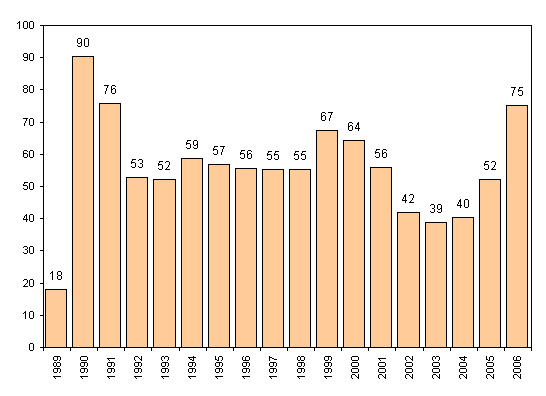
Между тем окончательный кризис советской системы привел к пику эмиграции. В 1990 году СССР покинули 205 тысяч евреев и членов их семей. Подавляющее большинство из них – 185,2 тысячи (90%), т.е. больше, чем за все предшествующее двадцатилетие 1970-1989 годов, когда их количество составило 178 тысяч, прибыли в Израиль. В 1991 году, к концу которого Советский Союз прекратил свое существование, из него эмигрировали еще 195 тысяч, из них 147,8 тысячи (76%) направились в Израиль. В 1992 году общее число евреев и членов их семей, выехавших за пределы бывшего СССР, снизилось до 123 тысяч, а в 1993 году составило 127 тысяч. Затем масштабы еврейской эмиграции постепенно сокращались до 1998 года, что во многом соответствовало снижению численности данной этнической группы в бывшем СССР, а значит, и количества потенциальных эмигрантов. В этот период немногим более половины (52-59%) мигрантов направлялись в Израиль (рис. 2).

Рисунок 2. Доля Израиля в эмиграции евреев и членов их семей из бывшего СССР, 1989-2006 годы, %

Финансовый кризис 1998 года в России привел к временному росту эмиграции из этой страны и в целом со всего постсоветского пространства7. Уровень эмиграции из Российской Федерации в Израиль в 1999 году вернулся к показателю 1990 года8. При этом доля Израиля как принимающей страны во всей эмиграции евреев и членов их семей из бывшего СССР повысилась до 67%. В условиях кризиса их намного возросшее желание эмигрировать реализовалось в основном благодаря возможностям, предоставленным израильским Законом о возвращении. В последующие годы в целом цифры постсоветской еврейской эмиграции снижались уже постоянно9. Это соответствовало как резкому сокращению еврейского демографического потенциала, остающегося на территории бывшего СССР, так и стабилизации ситуации и начавшемуся экономическому росту в большинстве постсоветских стран. В результате, по последней оценке, в 2006 году только примерно 10 тысяч евреев и членов их семей покинули эти государства.

После 11 сентября 2001 года роль США как страны назначения в постсоветской еврейской эмиграции резко упала: в 2002 и в 2003 годах лишь около 2,5 и 1,6 тысячи новых мигрантов соответственно были зафиксированы как получившие поддержку со стороны Общества помощи еврейским иммигрантам (HIAS). В последующем их число сократилось еще более: в 2004 году – до 1,1 тысячи; в 2005 – до 0,9 тысячи; в 2006 году – до 0,6 тысячи. Германия с начала 1990-х годов имела свою программу привлечения евреев из бывшего СССР. В 2002-2004 годах еврейская иммиграция с постсоветского пространства в эту страну была временно более многочисленной, чем в Израиль. Однако к середине текущего десятилетия Германия резко свернула свои усилия по привлечению евреев из постсоветских государств. В результате, в 2006 году только 1,1 тысячи евреев и членов их семей въехали в эту страну оттуда, тогда как еще в 2002 году это число составляло 19,3 тысячи. Сегодня только Израиль держит свои границы открытыми перед евреями всего мира и их близкими. Потому закономерно, что в 2006 году три четверти всех евреев и членов их семей, которые покинули постсоветское пространство, направились в эту страну.

По данным за 1989-2001 годы, когда все три только что отмеченные страны активно принимали евреев и членов их семей из бывшего СССР, очень близкое их количество прибыло в Израиль из Российской Федерации и Украины (табл. 4). В тот же период, по нашей оценке, в США из Украины въехало в 1,6 раза большее их число, чем из Российской Федерации, а для миграции в Германию разрыв был еще большим – в 2 раза. В результате, в эти годы доля выходцев из Украины в общем числе евреев-мигрантов из бывшего СССР и членов их семей была преобладающей среди переселившихся в США (41%) и особенно в Германию (56%). Удельный вес въехавших из Российской Федерации в эти страны был существенно ниже (26 и 27% соответственно). Среди переселившихся в Израиль доля выходцев из Украины (33%) была примерно той же как из Российской Федерации (32%).

Таблица 4. Эмиграция евреев и членов их семей из Российской Федерации и Украины в Израиль, США и Германию, 1989-2001 годы, тысяч человек.

Страна прибытия

Страна выбытия

Российская Федерация

Украина

Израиль

291,2

299,8

США*

81,1

128,6

Германия

45,0

92,7

* Оценка на основе неполных данных о распределении выехавших по странам, соответствующая общему числу эмигрантов из всего бывшего СССР.

Источник: Tolts M. Migration since World War I // The YIVO Encyclopedia of Jews in Eastern Europe / Ed. G.D. Hundert. New Haven, СТ, 2008. P. 1438 [in press].

Таким образом, всего в 1970-2006 годах за пределы бывшего Советского Союза выехало почти 1,9 млн. евреев и членов их семей. Большинство из них (около 1,15 млн., т.е. 60%) направились в Израиль. Понятно, что в этот весьма значительный миграционный поток входили часто те, кто прежде не идентифицировали себя как евреи в советских переписях населения и не относились властями в бывшем СССР к лицам данной национальности. Потому оценка общего числа евреев в современном мире, имеющих корни в бывшем Советском Союзе, равно как и их распределения по странам совсем не простая задача.