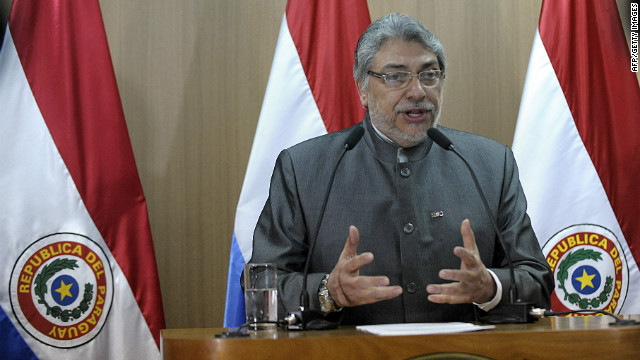
- Senate votes to remove President Fernando Lugo
- Schools cancel classes; hospitals prepare for possible violence
- Lugo calls the impeachment proceedings a coup
- Opponents say everything is within the constitution
(CNN) -- Paraguay's Senate, after a contentious impeachment trial, voted Friday to remove President Fernando Lugo from office.
The country's vice president, Federico Franco, was to assume presidential duties immediately. He is a member of the Authentic Radical Liberal Party, which supported the impeachment.
Lugo's defense team argued Friday that senators had prejudged him during the trial that drew hundreds of protesters outside the congressional building.
Lawyers for the embattled president called the proceedings unconstitutional and asked for more time to prepare their defense. The Senate president said the trial would continue as planned.
The vote to remove Lugo was 39 in favor, four against and two absent.
The lower chamber of Congress voted nearly unanimously Thursday to impeach Lugo, a former Catholic bishop.
But supporters of Lugo's are calling it an attempted coup d'etat, a charged term that raises fears of political or social unrest in the land-locked South American nation of 6.5 million.
The central issue behind the impeachment trial is a June 15 incident in which police clashed with landless peasants, resulting in 17 deaths.
Peasants in eastern Paraguay fired on police trying to evict them from private property, initiating the deadly confrontation, local authorities and state-run media said.
The violence occurred in Curuguaty, a remote community about 240 kilometers (150 miles) northeast of the Paraguayan capital, Asuncion, near the Brazilian border.
Lawmakers also leveled charges of lack of security, nepotism and a controversial land purchase.
Lugo replaced his interior minister and national police chief in the aftermath of the clash, but his handling of the matter irked his political opponents and supporters alike.
The stage for impeachment was set when members of a liberal party that supported him withdrew their backing, leaving the president nearly alone before Congress. Only one lawmaker in the lower chamber voted against impeachment, while 76 voted in favor.
Foreign ministers belonging to the Union of South American Nations, known as UNASUR, traveled to Asuncion to meet with Lugo before the trial.
"The nations of UNASUR have the right and the obligation to ensure that, based on technicalities, the legitimacy of democracy is not broken in Paraguay," Ecuadorian President Rafael Correa said.
If Lugo was ousted, the regional body may not recognize his successor, and sanctions would not be ruled out, Correa said.

 Paraguay's president admits 'love child'
 "There is international concern that this is some sort of attempt to end early the term of a democratically elected president," said Eduardo Gamarra, a Paraguayan political analyst.
Outside of the Curuguaty clash, the other arguments raised for Lugo's impeachment are political in nature, he said.
Even if the impeachment trial is a political move, the fact remains that nothing has been outside of the Paraguayan constitution, Gamarra said.
One lawmaker opposed to Lugo, Sebastian Acha, said that the number of votes for impeachment in the chamber of deputies leaves no doubt that it is not a partisan move.
Lugo has long "flirted" with groups of landless peasants who are prone to violence, culminating in the recent clash, Acha said.
Since Lugo came to office in 2008, lawmakers on several occasions have considered impeachment proceedings but stopped short, he said. But there is no fix that Lugo can make for the violence or for blaming the police, and impeachment is the way to proceed, the lawmaker said.
In an interview with Venezuelan network TeleSur, Lugo accused lawmakers of engaging in an "express coup d'etat" that happened overnight.
He accused those who benefited from corruption in earlier governments of orchestrating the impeachment and said he has a "very strong hypothesis" that an opposition presidential candidate is behind it. Lugo's term ends in 2013.
Anibal Carrillo, political secretary for a party loyal to the president, said that ousting the president is the goal of his enemies who didn't like that he tackled corruption or the land issue.
These forces "are carrying out a coup that may be legal under the constitution and legal by the numbers of votes, but it lacks justice; it lacks seriousness," he said.
CNN's Claudia Dominguez and CNN en Español's Carlos Montero and Fernando del Rincon and journalist Sanie Lopez contributed to this report.


No comments:
Post a Comment