
- Voting will begin Saturday, despite the potential for chaos after parliament was dissolved
- Former Mubarak official faces Muslim Brotherhood candidate
- It's not clear what authority the country's new president will have
- Egypt doesn't have a permanent constitution
(CNN) -- Egypt's presidential runoff begins Saturday, even as the country teeters on the edge of renewed chaos after a court ruling that dissolved the country's parliament and raised questions about whether the country's military will relinquish power.
Former Prime Minister Ahmed Shafik and Muslim Brotherhood-backed candidate Mohamed Morsi emerged from the first round of voting in late May to advance to the runoff, in which Egyptian voters will choose the country's first democratically elected president.
But that historic milestone has been overshadowed by rising concern about Thursday's Supreme Constitutional Court ruling dissolving parliament.
The court decreed that the rules governing the recent parliamentary elections were invalid. It tossed out a popularly elected parliament in which about half the seats were controlled by Islamists.
The court also invalidated a law that would have barred Shafik from running based on his affiliation with former President Hosni Mubarak, who stepped down after weeks of street protests in Egypt.

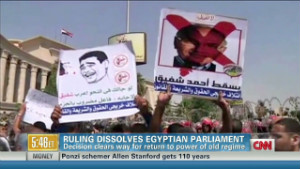 Tensions high before Egypt runoff vote
 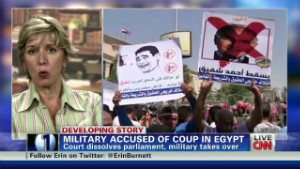 Is U.S. fiddling while Egypt burns?
 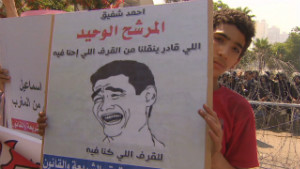 Egypt's political storm intensifies
  Egyptian street fighter vies for change
 It's unclear what authority the new president will hold. Egypt has no constitution to guide the government or clearly define the president's authority.
But the winner of the runoff election could be in a powerful position to deal directly with Egypt's military rulers, who are said to be planning to issue an interim constitution while a new permanent document is written and a new parliament elected.
That could prove especially true if Shafik, a former air force general, wins the runoff, analysts say.
Egyptian reform leader Mohamed ElBaradei, who himself had considered a presidential run, took to the social networking service Twitter on Thursday to call on the government to postpone the election.
"Electing president in the absence of constitution and parliament is electing an 'emperor' with more powers than deposed dictator. A travesty," he wrote.
The court decisions raised the talk of more street protests amid concerns that Egypt's ruling military council is consolidating power and does not intend to hand over authority to a popularly elected civilian government, as it has said it will do.
Still, preparations for the election were going ahead.
About 50 million polling cards have been distributed to polling places, according to a statement from Hatem Begato, the secretary general of the Higher Presidential Elections Commissions.
Egyptians living outside the country finished voting on June 9, according to the commission. Shafik led among Egyptians voting in Lebanon, Tunisia, Greece, Austria and Sierra Leone, according to the commission.
Morsi was leading among expatriates voting from Bangladesh, Sri Lanka, Malaysia, Jordan, Ethiopia, Yemen, Germany, Russia, Algeria and Sudan, the group said last week.


No comments:
Post a Comment