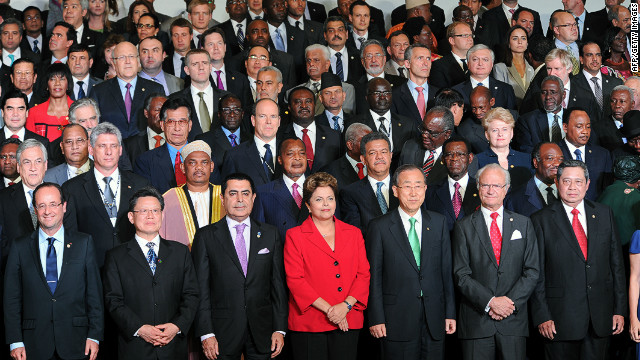
 Twenty years after the historic Earth Summit, world leaders once again gathered in Rio de Janeiro for the Rio+20 -- the United Nations Conference on Sustainable Development. But there were some notable absentees including U.S. President Barack Obama and Germany's Angela Merkel.
  Under the stewardship of U.N. Secretary-General, Ban Ki-moon (pictured) and Brazil's President Dilma Rousseff, governments have been negotiating over measures and actions laid out in "The Future We Want" -- a 53-page document which commits governments to creating a more sustainable path of development.
  Twenty years ago, 12-year-old Severn Suzuki addressed delegates at the first Rio Earth Summit. This year, it was the turn of 17-year-old New Zealander Brittany Trilford (pictured) to speak for a new generation of youth. She pulled no punches. "We are all aware that time is ticking, and we are quickly running out," she said. "You have 72 hours to decide the fate of your children, my children, my children's children. And I start the clock now."
  Speaking on the final day of the summit, U.S. Secretary of State Hillary Clinton described the agreed text as "a very good document." She added: "This is the vision on which we can build our dreams, our visions and it is important that the member states are united and work together."
  WWF Director General, Jim Leape was less enthusiastic about the progress made at Rio+20. "This was a conference about life: about future generations; about the forests, oceans, rivers and lakes that we all depend on for our food, water and energy. It was a conference to address the pressing challenge of building a future that can sustain us. Unfortunately, the world leaders who gathered here lost sight of that urgent purpose," he said in a statement.
  WWF's Leape added: "Too few countries prepared to press for action, Brazilian President Dilma Rousseff (pictured) chose to drive a process with no serious content -- to the planet's detriment."
  It wasn't all doom and gloom as the U.N. were able to announce tangible progress in many areas. A group of development banks (including the World Bank and European Investment Bank) will be investing $175 billion in public transport measures designed to reduce greenhouse gas emissions. Ban Ki-moon also revealed the creation of a "Sustainability Energy for All" initiative which has attracted private investment in excess of $50 billion.
  There was also positive news announced by Maldives' President Mohamed Waheed (pictured), who says that the country will be creating the largest marine reserve in the world. The waters surrounding all 1,192 of its islands would assume the status by 2017.
 Throughout the summit, thousands of activists has been taking to the streets of Rio to put pressure on governments to act on sustainability issues.
  The summit also attracted a series of artistic responses which formed a backdrop to the debates going on in the conference center and on the streets. This sculpture made from plastic bottles on Rio's Botafogo beach attracted the attention of many delegates and activists.
  The summit closed with "more of a whimper than a roar," according to Manish Bapna, acting president of the U.S. environmental thinktank, the World Resources Institute. "But it would be a mistake to conflate the outcome here with what's happening on the ground around the world," Bapna said. "Just look at Germany's shift to clean energy, Niger's efforts to re-green its landscape, or Rio's recently launched bus rapid transit system. We understand the challenges. We know the solutions. What we need is to build the political will for bolder leadership."


- Campaigners call Rio+20 summit a "hoax" and a "failure of epic proportions"
- The three-day meeting ended with an agreement on the document "The Future We Want"
- U.N. Secretary-General Ban Ki-moon says Rio+20 "affirmed fundamental principles"
- $513 billion has been committed to a number of causes, the United Nations says
(CNN) -- As delegates ended the three-day Rio+20 summit with a 53-page statement called "The Future We Want," activists slammed the U.N. conference on sustainable development as a "failure of epic proportions."
U.N. Secretary-General Ban Ki-moon described the document as a "firm foundation for social, economic and environmental well-being."
"Rio+20 has affirmed fundamental principles -- renewed essential commitments -- and given us new direction," Ban said in a statement.
Five cities fighting for climate survival
But the conservation group Greenpeace said the summit, formally known as the United Nations Conference on Sustainable Development, was "over before it started."

 Bianca Jagger: We're at tipping point
  Join the conversation on sustainability
  Rio's 'love hotels' open for business
 "One by one, the few proposed commitments and targets were deleted," Greenpeace International Executive Director Kumi Naidoo said in a statement.
"Rio+20 has been a failure of epic proportions," Naidoo added. "The only outcome of this summit is justifiable anger, an anger that we must turn into action."
Aid group Oxfam also slammed the once-in-a-decade event as a failure.
"Rio will go down as the hoax summit," Oxfam chief executive Barbara Stocking said. "We elect governments to tackle the issues that we can't tackle alone. But they are not providing the leadership the world desperately needs."
"Paralysed by inertia and in hock to vested interests, too many are unable to join up the dots and solve the connected crises of environment, equity and economy," her statement added.
Australian Prime Minister Julia Gillard defended the summit Saturday, saying she understood why many people were dissatisfied with the outcome, but stressed there had been progress.
"I do understand that there are people who will look at aspects of what has been resolved here and feel some sense that it's not enough, but we shouldn't forget where progress has been made," she said.
"I think agreeing to sustainable development goals is progress," Gillard added.
About 100 heads of state and government were among roughly 40,000 delegates who attended the meeting, which the U.N. called an "historic opportunity to define pathways to a safer, more equitable, cleaner, greener and more prosperous world for all."
It came 20 years after the Earth Summit in Rio which adopted Agenda 21, an action plan for sustainable development in the 21st century.
During the meeting, the U.N. said some $513 billion had been committed to a number of issues including energy, food security, access to drinking water and ocean management.
Pledges made during the summit include a 100-million tree planting program, plans to lift African women out of poverty through green economy businesses, and a commitment to recycle 800,000 tons of PVC each year, the United Nations said.
On Thursday, Ban launched a "Zero Hunger Challenge," an initiative backed by the U.N. Food and Agriculture Organization, the International Fund for Agricultural Development (IFAD), the World Food Programme (WFP), the U.N. Children's Fund (UNICEF), the World Bank and Bioversity International.
The U.N. described it as a "personal challenge" to everyone worldwide to work together to end hunger.
The "challenge" has five main goals, including "100%" access to adequate food all year around, ending malnutrition in pregnancy and early childhood, making all food systems sustainable, increasing productivity and income on family farms and eradicating all food waste.
The initiative earned praise from the head of Oxfam, which called it a "welcome ray of hope."


No comments:
Post a Comment